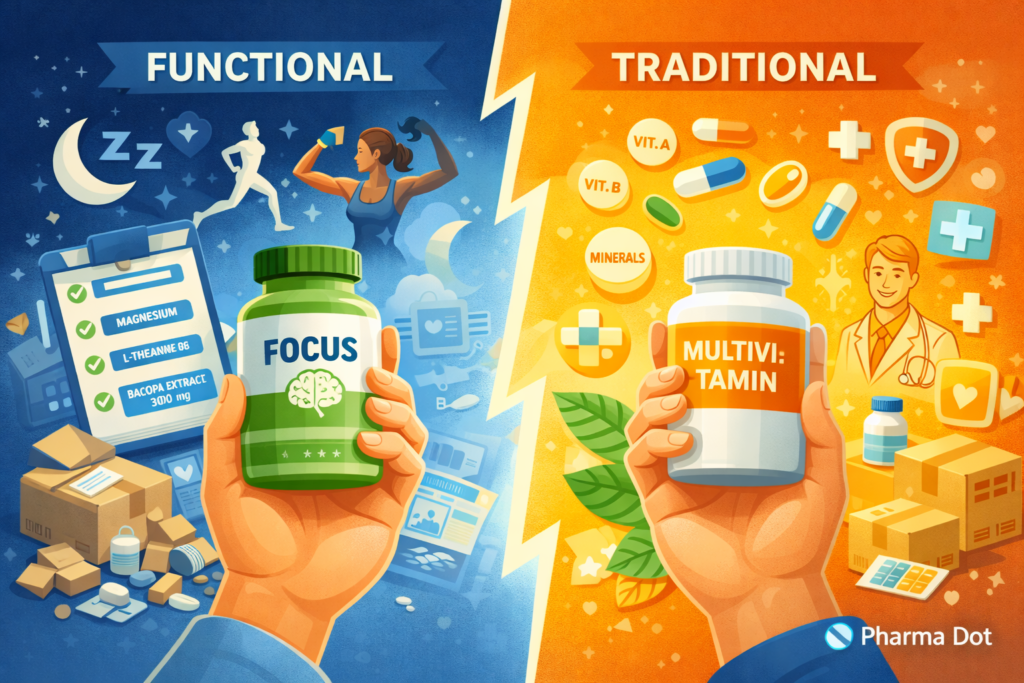
The dietary supplement market has undergone a marked change in recent years. Customers have stopped treating supplementation as a general 'health support' and have started to expect specific effects, tailored to their lifestyle, problems and goals. It is in this context that functional supplements and their advantages over classic products are increasingly being talked about.
Understanding this shift is crucial today for brands that want not only to launch a new supplement, but more importantly to build long-term sales and customer loyalty.
What are classical dietary supplements
Classic supplements are products that have dominated the market for years. The most common are:
- individual vitamins or minerals
- simple multivitamins
- products with broad, unspecified effects
Their communication is usually based on general slogans related to health, immunity or vitality. These types of supplements are easy to compare in price and very susceptible to competition, as the differences between brands are sometimes small.
Functional supplements - the answer to a specific need
Functional supplements are products designed with a specific use and a specific problem in mind.
Their characteristics are:
- clearly defined function
- precisely selected composition
- focus on real impact rather than general support
- adapting to the user's lifestyle
From the customer's perspective, this means a simple purchasing decision: the product either meets a need or it does not.
Why customer expectations have changed
The change in consumer expectations is no accident. It has been influenced by several factors:
- greater availability of knowledge and education
- growing awareness of the composition and quality of supplements
- fatigue from an excess of similar products
- the need for rapid, measurable results
Clients are increasingly asking not 'is it healthy', but 'does it work for me'.
The role of composition and dosage in functional supplements
In functional supplements, composition ceases to be a marketing list and becomes a tool.
Of key importance are:
- real doses of active substances
- synergies between components
- standardisation of extracts
- form of administration affecting bioavailability
In production practice, it is apparent that brands with a focus on functionality are far more likely to invest in a refined formulation than in elaborate promotional slogans.
Communication - the biggest difference between functional and classic
Classical supplements sell themselves with slogans. Functional supplements sell themselves with explanations.
The communication of functional products is based on:
- education
- transparency
- explaining the mechanism of action
- realistic expectations
This approach requires more work, but at the same time builds much more lasting trust in the brand.
Price and perception of value
Functional supplements are often more expensive than their classic counterparts. For the customer, however, the key is not how much the product costs, but whether they understand what they are paying for.
If the brand can make it clear:
- why the composition looks the way it does
- where the raw materials come from
- what effect the supplement is supposed to have
the higher price ceases to be a barrier and begins to be a confirmation of quality.
Why brands are increasingly choosing a functional direction
From the perspective of a contract manufacturer of supplements such as Pharma Dot, there is clearly a market shift towards functional products.
Brands opt for this model because:
- easier to stand out
- more difficult to compare directly on price
- build loyalty rather than a one-off sale
- scale up better in the long term
Will classic supplements disappear from the market
Classical supplements will not disappear completely. They will continue to be present as base and complementary products. However, it is functional supplements that are today setting the market direction and responding to current customer needs.
For new brands and products, it is this segment that offers the greatest growth potential.
Summary
Customer expectations of dietary supplements have changed permanently. The market has moved from general promises to specific functions and real effects.
Brands that can understand this change and design a supplement as a solution to a specific problem have a much better chance of long-term success. From a manufacturing and market practice perspective, it is functional supplements that are now becoming the new standard rather than a niche.




