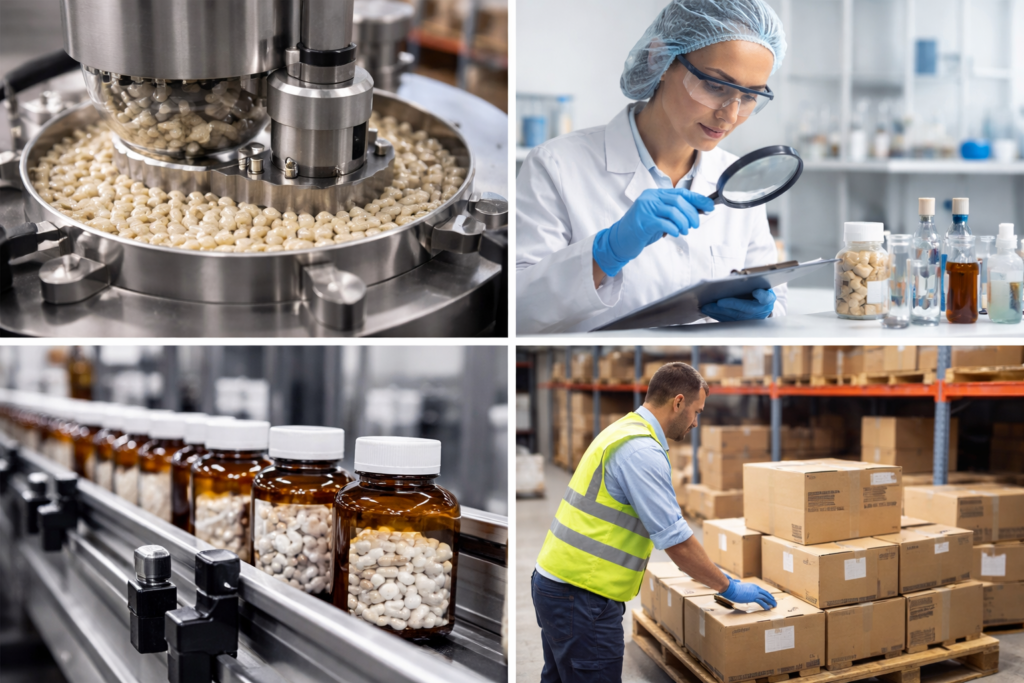
For many people, the production of dietary supplements appears to be a simple process of mixing ingredients and packaging them. In reality, it is a multi-step technological, quality and logistical process that must meet certain standards and ensure the reproducibility of each batch of product.
Understanding the step-by-step production process of a dietary supplement helps you to better plan your product launch, avoid mistakes and realistically assess the time needed for the project.
Stage 1 - Product concept and assumptions
Every supplement starts with an idea. At this stage, it is defined:
- what the product is to be used for
- for which client group it is intended
- what form the supplement will take
- what size the package will be
- what the target price will be
This stage is very important, as the composition, packaging, production costs and sales strategy later depend on the assumptions.
Stage 2 - Development of the composition of the supplement
Once the objectives have been defined, the formulation, i.e. the composition of the product, is developed. At this stage, it is selected:
- active ingredients
- doses
- forms of raw materials
- possible auxiliary substances
- Capsule or serving size
A well-designed formulation must take into account not only the performance of the product, but also the technological possibilities of production.
Stage 3 - Valuation and production plan
Once the composition and form of the product are established, a production quote can be prepared. The quotation includes:
- cost of raw materials
- production cost
- cost of packaging
- cost of labels
- cost of packaging
- qualitative research
The size of the first production and the timetable for implementation are also established at this stage.
Stage 4 - Label and packaging design
In parallel with the production preparation, a packaging and label design is created. The label must contain all the required information, including:
- the name of the product
- composition
- dosage
- alerts
- manufacturer's data
- lot number
- date of minimum durability
Packaging design is very important, as it has a major impact on the sales of the product.
Stage 5 - Procurement of raw materials and packaging
Once the design and quotation have been approved, they are ordered:
- resources
- capsules
- packaging
- labelling
- transport cartons
The waiting time for raw materials and packaging is often the longest stage of the entire production process.
Stage 6 - Production of the supplement
The production process depends on the form of the supplement, but most often includes:
- weighing of raw materials
- mixing of ingredients
- encapsulation or tableting
- quality control during production
- packaging
- labelling
- packing into cartons
Production records and quality control are maintained at each stage.
Stage 7 - Qualitative research
The finished product undergoes quality testing to confirm:
- conformity of composition
- microbiological purity
- no pollution
- compliance with quality requirements
Research is essential for a product to be marketed.
Step 8 - Storage and preparation for sale
Once production is complete, the supplement goes into storage, from where it can be:
- sent to customers
- forwarded for fulfilment
- distributed to wholesalers
- sent to marketplace warehouses
Logistics and stock management are very important at this stage.
How long does the entire supplement production process take
Depending on the product, the availability of raw materials and packaging, the whole process from idea to finished product usually takes several weeks to several months. The most time is usually taken up by the preparation of packaging and the availability of raw materials.
Therefore, planning for supplement production should begin well in advance.
Summary
The manufacturing process of a dietary supplement is a complex, multi-stage process involving product design, formulation development, packaging preparation, production, quality testing and logistics. Each of these stages has an impact on lead time, product cost and quality.
By understanding the entire process, it is possible to better plan the launch of the supplement and avoid many of the mistakes that most often occur in the first productions.




