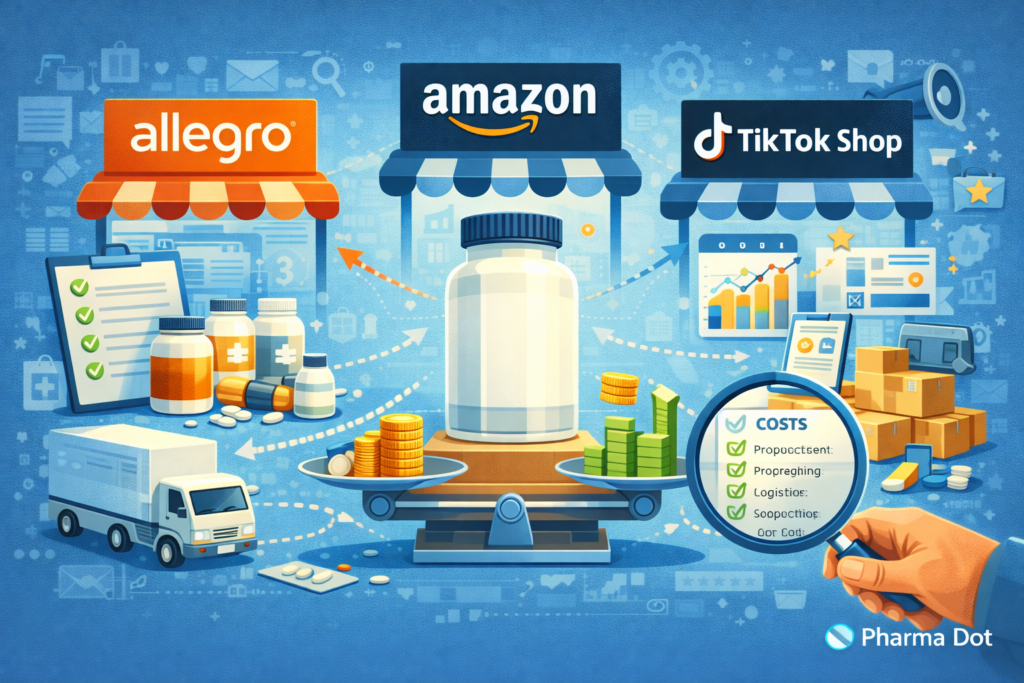
How to prepare supplements for sale on Allegro, Amazon and TikTok Shop
Selling dietary supplements on marketplaces offers great opportunities for scaling, but requires much more preparation than launching your own online shop. Allegro, Amazon or TikTok Shop have their own specific rules, algorithms and logistical requirements. A brand that wants to sell there successfully has to think not only about the product, but about the entire sales ecosystem.
Below are the key elements that need to be fine-tuned before a supplement can go multi-channel.
Compliance of the product with the requirements of the marketplace
Each platform has its own regulations for the sale of dietary supplements. These apply to both descriptions and product documentation.
The most common requirements are:
- full product composition
- manufacturer information
- batch data
- compliance with local regulations
Formal errors can result in the blocking of the offer or the seller's account. That is why it is worthwhile to ensure a complete set of documents and data transparency at the production stage.
Description and product sheet under algorithm
Marketplaces operate on the basis of algorithms that analyse keywords, offer structure and completeness.
A good product sheet should include:
- precise title
- clear description of the supplement's functions
- detailed dosage information
- clear graphics
- answers to potential customer questions
The clearer and more complete the offer, the greater the chance of high visibility in search results.
Images and graphics - a decisive element
On marketplaces, the customer often makes a decision in seconds. Graphics are the first element that attracts attention.
It is worth taking care of:
- professional packshots
- visual presentation of benefits
- legibility of the label
- consistency of visual identity
Well-crafted visuals increase conversions and reduce the number of questions and returns.
Logistics - the most critical point
Multi-channel sales mean higher volumes and higher customer expectations. Delivery times, completeness of orders and handling of returns have a direct impact on the seller's rating.
The most common challenges are:
- synchronisation of inventories
- rapid availability update
- handling promotions and sales spikes
- control of expiry dates
In practice, many vendors are switching to external fulfilment to ensure stable handling of the growing number of orders and to avoid operational chaos.
System integrations
Selling on several platforms at the same time requires the right technological background.
Essentials:
- integration with warehouse systems
- automatic updating of stocks
- handling courier labels
- sales reporting
Without these elements, errors very quickly occur, which translate into negative feedback and a decrease in the visibility of the offer.
Pricing strategy on marketplaces
Marketplaces are a very price-competitive environment. When setting your price, you need to consider:
- platform commissions
- sponsored advertising costs
- seasonal promotions
- logistics costs
The price must allow a margin to be maintained even with commissions and discounts, otherwise the sale will generate turnover with no real profit.
Opinions and reputation
On Allegro, Amazon or TikTok Shop, customer reviews are one of the key factors in determining sales.
It is therefore worthwhile:
- ensure flawless processing of first orders
- respond quickly to questions
- solve any problems that may arise
Operational quality translates directly into a position in the algorithms and the trust of subsequent customers.
Scaling up sales
Marketplaces allow you to dynamically increase your sales, but only if your operational base is ready for it.
From the perspective of the brands working with Pharma Dot, it is clear that the best performing companies are those that:
- prepared the logistics in advance
- have repeatable production
- control inventories
- think of expansion as a process rather than a leap
Summary
Selling dietary supplements on Allegro, Amazon and TikTok Shop is a huge opportunity for brand development, but requires comprehensive preparation. Product, logistics, technology and communication must form a coherent system.
Brands that treat marketplaces as part of a long-term strategy, rather than a quick sales experiment, have the best chance of scaling steadily and building a strong market position.




