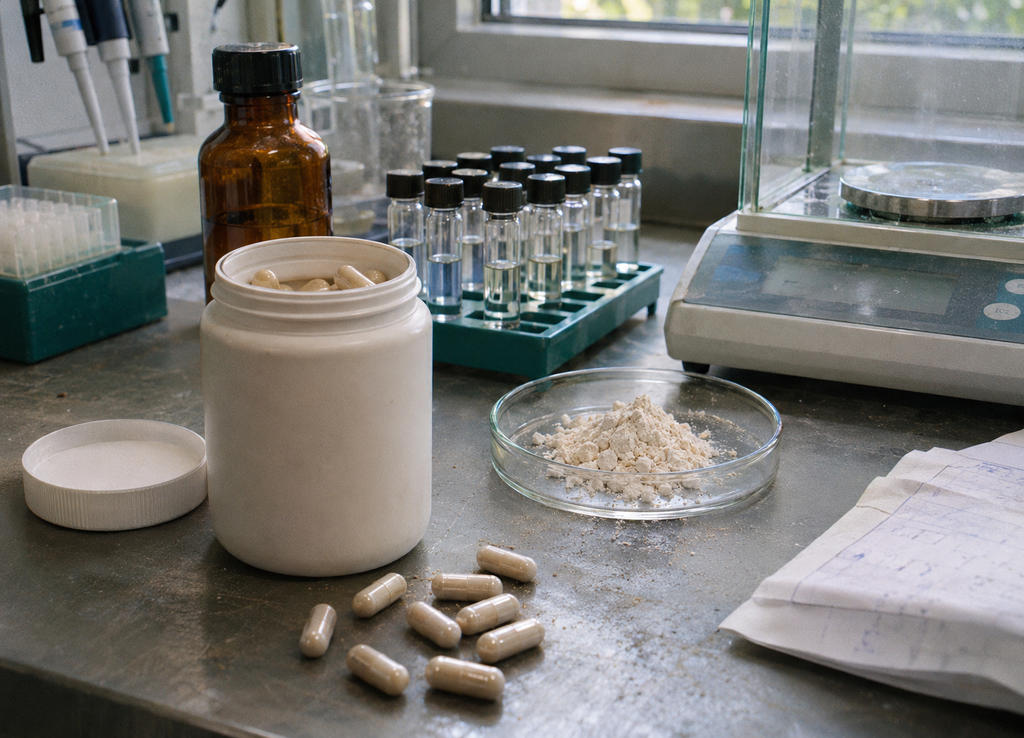
The product looks ready. The formula has been approved, the label is ready to be printed, the packaging has been ordered, and the launch date has already been added to the campaign calendar. That’s when a question arises that has the power to bring the whole project to a halt: how do we actually know that the finished batch contains what we claim it does, is safe, and will retain the required quality until the end of its shelf life?
The answer should not simply be: „the supplier has sent the certificate”. The quality of the finished supplement also depends on transport, storage, production, packaging and changes that occur over time.
That is precisely why it is worth planning research into food supplements before production begins, rather than only once the finished product is in stock.
What tests should be carried out on dietary supplements? The short answer
There is no single, universal set of analyses that is suitable for every food supplement. The scope of testing should be determined by the formulation, the origin of the raw materials, the product form, the manufacturing process, the target group and the identified risks.
In practice, the control plan should comprise three levels:
- verification of raw materials and their documentation,
- process control and testing of the finished batch,
- an assessment of the product’s stability and its suitability for the packaging.
The most common tests carried out are for microbiological safety, the content of key ingredients, relevant contaminants and physicochemical parameters. However, the exact scope must always be tailored to the specific product.
A food supplement is a foodstuff, and responsibility does not end with the formulation
A food supplement is not a medicine. It therefore does not undergo the same registration process or clinical trials as a medicinal product. However, it is still a foodstuff placed on the market, and the entity responsible for the product must ensure its safety and compliance with food law.
Notification to the Chief Sanitary Inspector of the first placing of a food supplement on the market does not constitute laboratory confirmation of the quality of each batch. A well-planned inspection is intended to demonstrate that the product does indeed meet the established requirements.
We have described the obligations relating to placing a product on the market in more detail in the article How do you market a food supplement in Poland?
Raw material testing: quality begins before production
If an incorrect ingredient enters the production process, the laboratory may detect the problem, but it will not be able to salvage the batch that has already been produced. That is why quality control begins with the qualification of suppliers and the verification of raw materials.
For each ingredient, there should be a specification setting out, amongst other things, its identity, purity, required parameters and permissible limits. The supplier usually provides a certificate of analysis (CoA) specific to a particular batch. This document is important, but it should not be treated as an automatic answer to every question.
The scope of additional verification depends on the level of risk. A well-known raw material from a regular supplier is assessed differently from a new plant extract with an increased risk of pesticide residues, heavy metals or adulteration.
In practice, you can check, amongst other things:
- the identity of the raw material,
- the content of the declared component or marker,
- purity and physicochemical properties,
- microbiological quality,
- the presence of allergens or the risk of cross-contamination,
- heavy metals, pesticide residues, mycotoxins or other contaminants specific to the ingredient in question.
This does not mean that every raw material has to be tested for everything every single time. The aim is to draw up a logical plan: we know what risk we are monitoring, why we have chosen a particular test, and how often we repeat it.
Process control: quality is established before it reaches the laboratory
The final test result is merely a snapshot of the sample taken. It is no substitute for monitoring the production process.
During production, key factors include accurate weighing, the order in which ingredients are added, mixing time and uniformity, ambient conditions, line hygiene and measures to prevent the mix-up of raw materials. For capsules, unit weight is also checked, whilst for liquids or gels, pH, water activity and filling parameters may be important.
A good system ensures quality at every stage, and testing of the finished batch confirms that the process has worked as intended.
What tests are carried out on the finished supplement?
The scope of the finished product inspection should be based on its specifications. This is a document in which the required parameters and acceptance criteria are set out in advance. A batch may only be released for sale once the production documentation and the results specified in the inspection plan have been reviewed.
1. Microbiological tests
Their purpose is to check that the product does not contain an unacceptable number of microorganisms or specific pathogenic microorganisms. The risk depends on the type of ingredients, the water activity, the process and the form of the product.
Dry mineral capsules will have a different risk profile to gummies, syrups, preparations containing plant-based ingredients or products with a high protein content. For this reason, the microbiological panel should also be tailored to the specific formulation, rather than being copied thoughtlessly from another project.
2. Labelling of the content of key ingredients
If a label states a specific amount of a vitamin, mineral or other active ingredient, there must be evidence to support that claim. Analysis makes it possible to assess whether the actual content falls within the accepted criteria, whilst taking into account natural variations in the manufacturing process and changes occurring during storage.
It is not always practical to label every ingredient in every batch. Routine checks take into account, amongst other things, the significance of the substance, its susceptibility to degradation, the dosage, the risk of error and the process history. However, the plan must reliably ensure compliance with the formulation.
3. Pollutant testing
There is no single list of contaminants that applies to all supplements. Depending on the ingredients and their origin, tests are carried out for, for example, lead, cadmium, mercury or arsenic, pesticide residues, mycotoxins, polycyclic aromatic hydrocarbons, solvent residues or other compounds that may be present in a given supply chain.
A comprehensive panel put together „just in case” may look impressive, but it is not always the best use of the budget. An analysis based on the product’s actual risks is of far greater value.
4. Physicochemical, organoleptic and performance parameters
A product should not only be safe, but also consistent and fit for purpose. Therefore, its appearance, smell, taste, colour, moisture content, pH, water activity, bulk density, uniformity and other parameters specific to the form in question are checked.
A powder that clumps together in its packaging after a few weeks may still contain the declared ingredient, but it is not a product of full value to the customer. Differences in the appearance of successive batches may also give rise to mistrust.
Stability studies: what will happen in six, twelve and eighteen months’ time?
The result obtained on the date of manufacture does not yet answer the question of what the product will be like at the end of its stated use-by date.
Some vitamins gradually lose their potency, oils may oxidise, flavours may fade, powders may absorb moisture, and live bacterial cultures may decrease in number. The rate of these changes depends on the formulation, temperature, light, oxygen and the type of packaging used.
Stability studies monitor key parameters at specified time points, under real-world conditions and, in some cases, under accelerated conditions. They help to determine the shelf life, storage conditions and any necessary safety margin for an ingredient susceptible to degradation.
It is important not to set an expiry date simply because „similar products have a two-year shelf life”. A similar label does not mean the same shelf life.
The packaging is also part of the product
A jar, sachet, bottle or blister pack is not merely an element of visual identity. They protect the contents from moisture, oxygen, light, damage and contamination.
It is therefore advisable to assess stability in the final packaging. A change in material, closure or supplier may require a reassessment, particularly in the case of oils, probiotics, hygroscopic powders and light-sensitive ingredients.
Does every analysis have to be carried out for every batch?
Not always. A sensible control plan combines tests carried out upon release of each batch with periodic analyses and supplier audits. The frequency may depend on the risk associated with the ingredient, process stability, historical results, batch size and the level of confidence in the supply chain.
A new supplier, a change in the country of origin of the raw material, or a modification to the formulation, process or packaging are all indications that the scope of testing should be reviewed. The fact that there have been no issues for several years does not mean that the control plan should remain unchanged without review.
The method of sampling is also important. The result will not be reliable if the sample is not representative of the batch or has been transported incorrectly. A procedure is therefore required for the collection, identification and storage of reference samples.
The scope of the research depends on the form of the supplement
The same active ingredient may require a different approach depending on whether it is incorporated into a capsule, liquid, gel or powder.
- Capsules and tablets: The mass and uniformity of the units, the content of key components, and performance parameters such as disintegration may be important.
- Powders: The properties monitored include, amongst others, moisture content, homogeneity of the mixture, free-flowing properties, solubility and tendency to cake.
- Liquids and sweets: pH, water activity, microbiology, the effectiveness of the preservation system used and sensory stability are becoming increasingly important.
- Oils: The processes of oxidation, aroma, flavour and protection against light and oxygen are assessed.
- Probiotics: The identity of the strains and the number of viable microorganisms are crucial; these should ideally also be checked towards the end of the shelf life.
- Plant extracts: Particular attention may need to be paid to botanical identity, marker content, pesticides, heavy metals, mycotoxins and microbiology.
In sports supplements, additional testing for banned substances can enhance a brand’s credibility and minimise the risk to athletes. However, such testing is not automatically a mandatory feature of every product aimed at active people.
How do you plan a supplement trial step by step?
It is best to start whilst you are still working on the formulation. That way, the results of the risk analysis can influence the choice of raw materials, suppliers, processes and packaging before any changes become costly.
The practical plan includes:
- Defining the quality parameters and declarations to be included on the label.
- An assessment of the risks associated with each raw material, its origin and product form.
- Establishing the specifications for raw materials, semi-finished products and finished goods.
- The qualification of suppliers and the rules for verifying their documents and results.
- Selection of checks carried out during production.
- Identification of the tests required for batch release and periodic analyses.
- Planning for stability in the final packaging.
- Establishing procedures for sampling, documenting results and handling non-conformities.
This approach should be consistent with the overall implementation schedule. We discussed how much time needs to be set aside for each stage in our article How long does it take to develop a dietary supplement?
The most common mistakes made when assessing food supplements
The first mistake is to regard the supplier’s certificate as full confirmation of the finished product’s quality. The second is to test only the prototype. A sample produced on a small scale does not yet confirm the reproducibility of a commercial batch.
It is also common to see analyses chosen at random, without any link to risk assessment. The brand then pays for a detailed report but does not receive answers to the most important questions about its product.
Other issues include only commencing testing once the labels have been printed, neglecting stability testing, the lack of reference samples, and scheduling the product launch before the results required for batch release have been obtained. Time pressure does not alter the time required by the laboratory or the product’s biological properties.
Research into dietary supplements from a business perspective
Research is sometimes seen as a cost that does not increase the number of packs sold. In practice, however, failing to carry it out can prove far more costly: a delayed launch, label changes, a recall of the entire batch, a product withdrawal or a loss of customer trust.
A well-thought-out plan is not about commissioning as many tests as possible. It is about asking the right questions at the right stage. What could go wrong? Which parameter is critical? How will we check this? What will we do if the result falls outside the specification?
At Pharma Dot, we help to integrate formulation development, contract manufacturing, regulatory requirements and quality control into a single process. As a result, testing is not an afterthought carried out just before launch, but an integral part of a well-planned implementation.
If you are developing your own dietary supplement and want to determine which analyses are appropriate for a specific formulation, please get in touch with us. We will help you take your idea and specifications all the way to a finished product ready for sale.
Frequently Asked Questions
Is it compulsory to carry out research into food supplements before they go on sale?
The operator placing food on the market is responsible for its safety and compliance with the law. The regulations do not specify a single, standardised set of laboratory tests for all food supplements. The scope of testing should be determined on the basis of a risk assessment, the product’s characteristics and the applicable limits.
Is a certificate of analysis for the raw material sufficient?
A CoA is an important part of the documentation, but it is not always sufficient. It is necessary to assess the supplier’s reliability, the document’s compliance with the specification, and the need for periodic or independent verification. Furthermore, a raw material certificate does not automatically confirm the quality of the finished batch.
Does a dietary supplement have to undergo clinical trials?
A supplement is a food product, not a medicine, and therefore does not undergo the standard clinical trial process required for medicinal products. However, the brand must ensure safety, compliance of its composition and marketing communications with the law, and have a basis for the claims it makes.
How much do studies into dietary supplements cost?
The cost depends on the number of analyses, the type of matrix, the methods used and the frequency of testing. A simple panel may cost considerably less than the analysis of multiple active substances or a comprehensive screening for contaminants. The scope should be determined following a risk assessment, rather than solely on the basis of the lowest price for a package.
How long do the laboratory tests on the supplement take?
Depending on the method and the laboratory, results may be available after a few days or a few weeks. Stability studies, by definition, take longer, as they monitor the product at successive time points. The timeframes for these analyses must be taken into account in the launch schedule.
Does every batch of a supplement need to be tested in the same way?
Not all parameters need to be monitored with the same frequency. The plan may combine checks on each batch, periodic testing and supplier qualification. However, it should be documented, risk-based and updated following any changes to raw materials, processes, suppliers or packaging.








