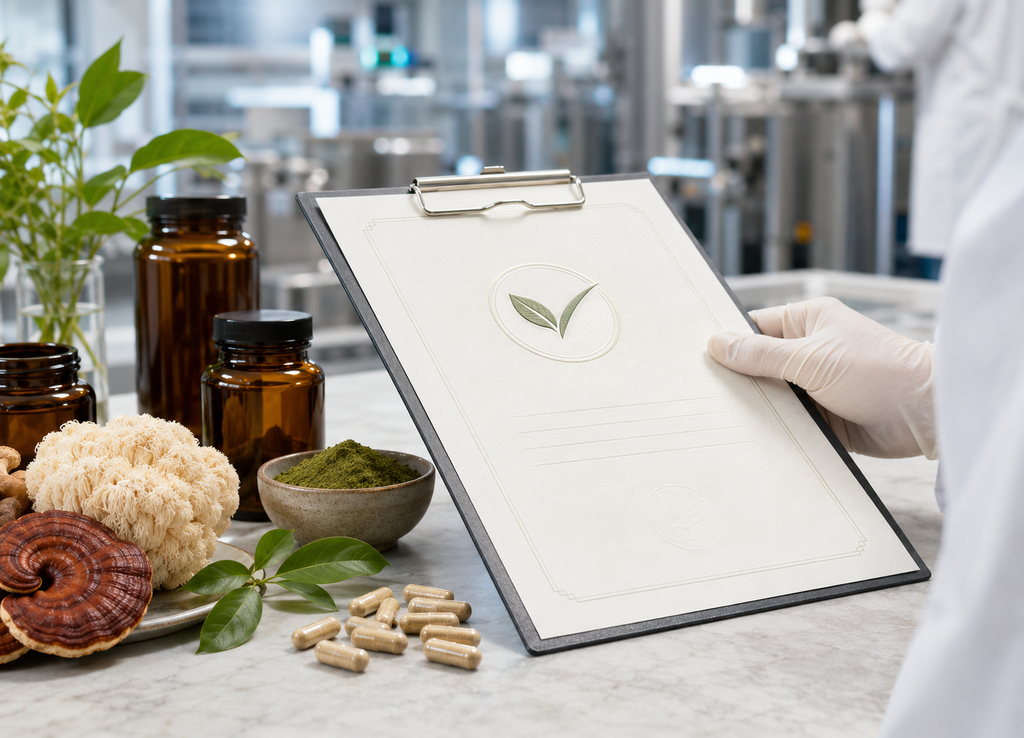
Pharma Dot has obtained certification in accordance with Regulation (EU) 2018/848 of the European Parliament and of the Council on organic production and the labelling of organic products. This marks the next stage in the development of our expertise and, at the same time, opens up new opportunities for brands interested in creating certified organic products, organic dietary supplements and organic functional foods.
The certificate confirms that Pharma Dot complies with EU requirements regarding the production of organic products. It covers processed agricultural products intended for use as food, as well as the list of organic products specified in the document.
For our clients, this means the opportunity to develop products aimed at consumers who value not only the functionality of the product, but also the verified origin of its ingredients, supply chain transparency and compliance with the official organic certification scheme.
What environmental certification has Pharma Dot been awarded?
Certificate number PL-EKO-02.616-0032560.2026.001 was issued to Pharma Dot Sp. z o.o. by the certification body PNG Sp. z o.o., operating under code PL-EKO-02.
This document is valid from 14 August 2026 to 17 August 2027 and was issued in accordance with Article 35(1) of Regulation (EU) 2018/848.
The certificate specifies:
- type of activity: preparation,
- product category: processed agricultural products intended for use as food,
- production methods: organic and non-organic production,
- a detailed list of the 51 organic products covered by the current scope.
The certificate is available on the EU’s TRACES system, which allows its authenticity and scope to be publicly verified.
What does ‘preparing’ organic products mean?
In Regulation (EU) 2018/848, the concept of ‘preparation’ has a much broader meaning than the colloquial term ‘product preparation’.
It includes, amongst other things:
- the preservation and processing of organic products,
- packaging,
- marking,
- making changes to labelling relating to organic production,
- other operations carried out on the product before it is placed on the market.
This means that the environmental management system covers more than just the origin of raw materials. The entire process is monitored – from the selection of ingredients and their traceability, through to product preparation, packaging, storage and correct labelling.
The certificate obtained confirms that Pharma Dot meets the requirements set out for operating in an environmentally friendly manner within the scope specified in the document.
Which products are covered by the Pharma Dot certificate?
The detailed list contained in the certificate comprises 51 organic items. These include, amongst others:
- extracts from functional mushrooms, such as Lion’s Mane, Reishi, Cordyceps and Chaga,
- plant extracts and adaptogens, including ashwagandha, Rhodiola rosea, Bacopa monnieri, ginseng and moringa,
- chlorella, spirulina, acerola and camu camu,
- formulas that support concentration, immunity, hormonal balance and the digestive system,
- herbal blends and teas,
- other processed agricultural products intended for use as food.
This range is well suited to the growing market for products based on plant-derived ingredients, botanical extracts, functional mushrooms and convenient forms of functional food.
However, every new project requires an individual analysis of the formulation, raw materials, process and scope of certification. The mere fact of working with a certified organisation does not mean that any product automatically becomes an organic product.
Does an organic certificate mean that any product can be labelled as ‘organic’?
No. Terms such as ‘eco-friendly’, ‘BIO’ and ‘organic’ are regulated by law and cannot be used merely as marketing buzzwords.
For a specific product to be marketed as organic, it must meet the relevant requirements concerning, amongst other things:
- the origin and certification of ingredients,
- the composition of the recipe,
- authorised additives and processing aids,
- the traceability of individual batches,
- the separation of organic production from non-organic production,
- supplier and process documentation,
- preparation and storage of the product,
- packaging labelling,
- ensuring that the product is covered by the appropriate scope of certification.
In the case of pre-packaged organic food produced within the European Union, the use of the EU organic production logo is subject to specific rules. The product must contain at least 95% organic ingredients of agricultural origin, and the remaining ingredients must meet additional requirements.
The relevant control unit code and information on the origin of the agricultural raw materials must also be displayed alongside the logo.
A natural product versus a certified organic product
The terms ‘natural’ and ‘organic’ are not synonyms.
A product may contain ingredients associated with nature, such as plant extracts, herbs, fruit or functional mushrooms, whilst at the same time failing to meet the requirements for it to be labelled as organic.
An organic certificate provides formal confirmation that the product and the associated processes meet specific legal requirements. This gives the brand a much stronger basis for communication than simply using general claims about naturalness.
For consumers, an eco-label is a clear indication that a brand’s claims are subject to an external verification system.
What does the Pharma Dot certificate mean for customers?
Expanding Pharma Dot’s remit to include organic products enables us to handle a wider variety of product projects.
These new opportunities are of particular interest to:
- a brand of supplements expanding its organic range,
- manufacturers and owners of functional food brands,
- companies that use organic plant extracts,
- brands specialising in functional mushrooms,
- projects based on superfoods and adaptogens,
- shops selling healthy and organic food,
- private-label brands aimed at the Polish market and other European Union markets,
- businesses wishing to distinguish their product on the basis of a verified standard, rather than merely a marketing claim.
By combining our expertise in product development, technology, packaging and regulatory affairs, we are able to analyse a project not only in terms of the formulation itself, but also in terms of its positioning, dosage form, labelling and market launch potential.
Organic and non-organic production within a single system
The Pharma Dot certificate covers both organic and non-organic production. This enables the development of both conventional and organic product projects whilst maintaining the procedures required to keep them separate.
In practice, the preparation of organic food requires it to be kept separate from non-organic products, either in terms of time or space, and involves following appropriate procedures relating to raw materials, processes, cleaning, documentation and batch traceability.
This is important for the customer because it enables them to work on different portfolio options – for example, a standard product range and a separate premium organic range – in collaboration with a single partner.
What might the process of creating an eco-friendly product look like?
The process begins with an analysis of the concept and a determination of whether the planned product can meet the requirements for organic production.
The next steps may include:
- Defining the product’s function, target audience and format.
- A preliminary assessment of the formulation in terms of environmental requirements.
- Selection of raw materials accompanied by the relevant documentation.
- Verification of the suitability of additives, flavourings and processing aids.
- Developing the formulation and product form.
- Preparation of documentation and product qualification under the certification scheme.
- Designing signage that complies with the law.
- Preparing and packaging the product in accordance with the required procedures.
- Ensuring the traceability of finished batches.
We assess whether a product can be labelled as organic on a case-by-case basis, taking into account its actual composition, the origin of its ingredients, the planned production process and the applicable regulations.
An organic certification as a key to a brand’s credibility
In the crowded market for dietary supplements and functional products, simply using a trendy ingredient is increasingly rarely enough to create a clear competitive edge.
Brands need specific and verifiable arguments. Environmental certification can be one such argument, particularly if it is consistent with the product’s overall positioning: its formulation, packaging, marketing communications and target audience.
For Pharma Dot, obtaining this certification means expanding its opportunities for collaboration with clients who wish to develop products based on certified organic raw materials and a transparent process.
This also marks the next step in Pharma Dot’s development as a partner for modern brands in the fields of dietary supplements, functional foods, plant-based products and functional foods.
Are you planning to develop an eco-friendly product?
If you are developing a dietary supplement, a product based on plant extracts, functional mushrooms, adaptogens or another form of functional food, and are considering an organic option, please contact Pharma Dot.
We will analyse the concept, the formulation, the availability of suitable raw materials and the requirements that a specific product must meet. This will enable us to assess the project’s realistic prospects for certification right from the start and to plan the subsequent stages of implementation.
Frequently Asked Questions
Does Pharma Dot hold an organic certificate?
Yes. Pharma Dot holds a certificate in accordance with Regulation (EU) 2018/848. The current certificate is valid from 14 August 2026 to 17 August 2027.
Can Pharma Dot produce organic dietary supplements?
The certificate covers the production of specified processed agricultural products intended for use as food. The possibility of producing a specific dietary supplement or functional food product requires individual verification of the formulation, ingredients, process and scope of certification.
Is every product containing an organic ingredient an organic product?
No. The use of a single organic ingredient does not automatically mean that the entire product can be sold as organic. The assessment covers the composition, the proportions of the ingredients, the production process, the documentation and the product labelling.
Does an organic certificate replace the notification of a food supplement?
No. Organic certification and the formalities involved in placing a food supplement on the market are separate matters. The product must comply with both the requirements for organic production and all other regulations applicable to the relevant food category.
Can an organic product carry the EU organic logo?
Yes, provided it meets the conditions set out in the regulations on organic production. In the case of pre-packaged organic food produced in the EU, the logo is generally compulsory, but its use is subject to compliance with requirements relating to composition, production processes, controls and labelling.
Is it possible to create an eco-friendly private-label product?
Such projects may be developed on a contract manufacturing basis; however, each one requires prior qualification. The formulation, suppliers, raw material documentation and the possibility of obtaining the appropriate certification for the product must be verified.




