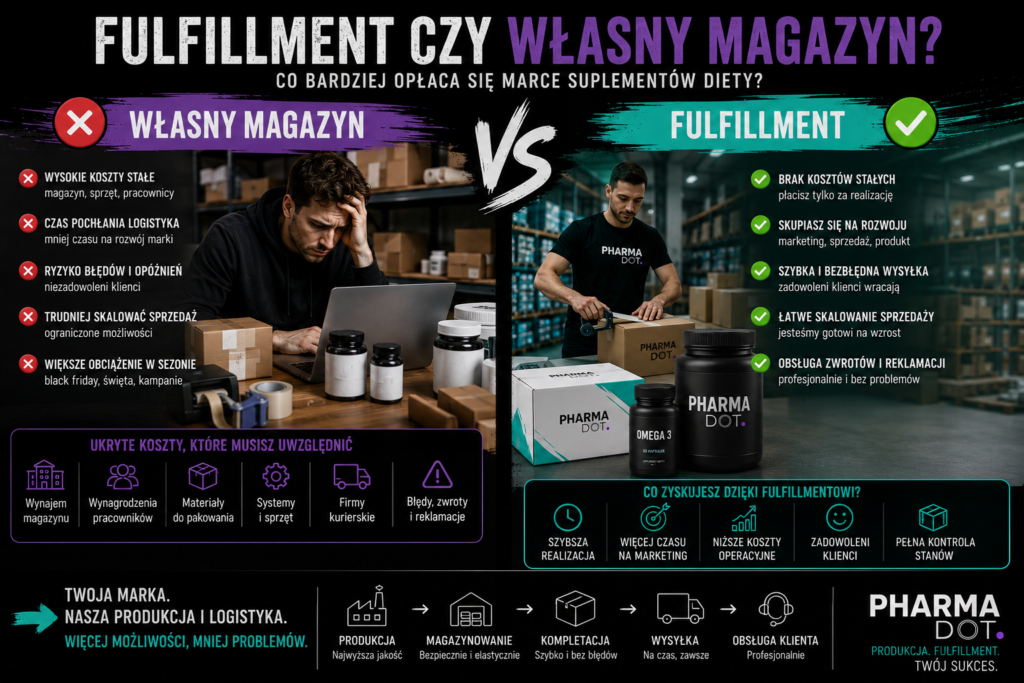
Sooner or later, every dietary supplement brand faces the same question: should it store and dispatch its products in-house, or outsource its logistics to an external partner?
When you first start out, having your own warehouse may seem like the cheapest option. However, as the number of orders increases, the situation often turns out to be quite different. It is logistics that begins to determine profitability, the quality of customer service and the potential for the brand’s future growth.
Your own warehouse – when does it make sense?
When they first start out, many companies do the following themselves:
- stores products,
- packs parcels,
- prepares labels,
- accepts returns,
- contacts courier companies.
With a dozen or so orders a day, this model is often sufficient. The problem arises when sales start to grow rapidly.
What happens as sales increase?
The more orders there are, the more time is taken up by operational tasks:
- product picking,
- packing parcels,
- printing waybills,
- stock control,
- handling complaints and returns.
As a result, instead of growing sales, the brand owner spends most of the day dealing with logistics.
What is fulfilment?
Fulfillment is a comprehensive logistics service for products.
The fulfilment partner takes on the following responsibilities, amongst others:
- storage,
- order fulfilment,
- packaging,
- delivery,
- returns processing,
- stock control.
This allows the brand to focus on product development and sales.
The main advantages of fulfilment
More and more brands are opting to outsource their logistics, as this enables them to:
- reduce order fulfilment times,
- to reduce the number of errors,
- reduce fixed costs,
- it is easier to scale sales,
- avoid investing in your own warehouse and staff.
This is particularly important during periods of increased sales, such as Black Friday, the festive season or viral social media campaigns.
What about the costs?
Many business owners assume that having their own warehouse will always be cheaper.
In practice, the following should be taken into account:
- property letting,
- warehouse equipment,
- staff salaries,
- packaging materials,
- warehouse systems,
- equipment,
- insurance,
- the costs of errors and complaints.
Only once all the expenses have been totalled can a realistic comparison be made between the two models.
Fulfillment helps you scale your business
One of the greatest advantages of fulfilment is the potential for rapid growth.
If a marketing campaign or collaboration with an influencer generates several thousand orders in a short space of time, a professional logistics provider is equipped to handle such volumes.
For the brand, this means greater security and a better customer experience.
When is it worth switching to fulfilment?
Most often, the time for a change comes when:
- the number of orders is steadily increasing,
- Logistics is starting to take up most of the team’s time,
- there are delays in dispatch,
- the company is planning an intensive marketing campaign,
- The owner wants to focus on developing the brand rather than packing parcels.
How does it work at Pharma Dot?
At Pharma Dot, we offer not only contract manufacturing of dietary supplements, but also a comprehensive fulfilment service. This means our partners can entrust us with the entire process – from production, through warehousing, right through to the dispatch of finished orders to customers.
This approach helps to streamline the entire operational chain, reduce lead times and ensure a consistent standard of service.
Summary
There is no single solution that suits every brand. When a business is first starting out, having its own warehouse may be sufficient; however, as sales grow, fulfilment often proves to be a more efficient and scalable model.
Brands that wish to grow their sales, invest in marketing and respond quickly to market needs are increasingly viewing logistics as an area best left to specialists. This allows them to focus on what matters most – building a strong brand and developing new products.




