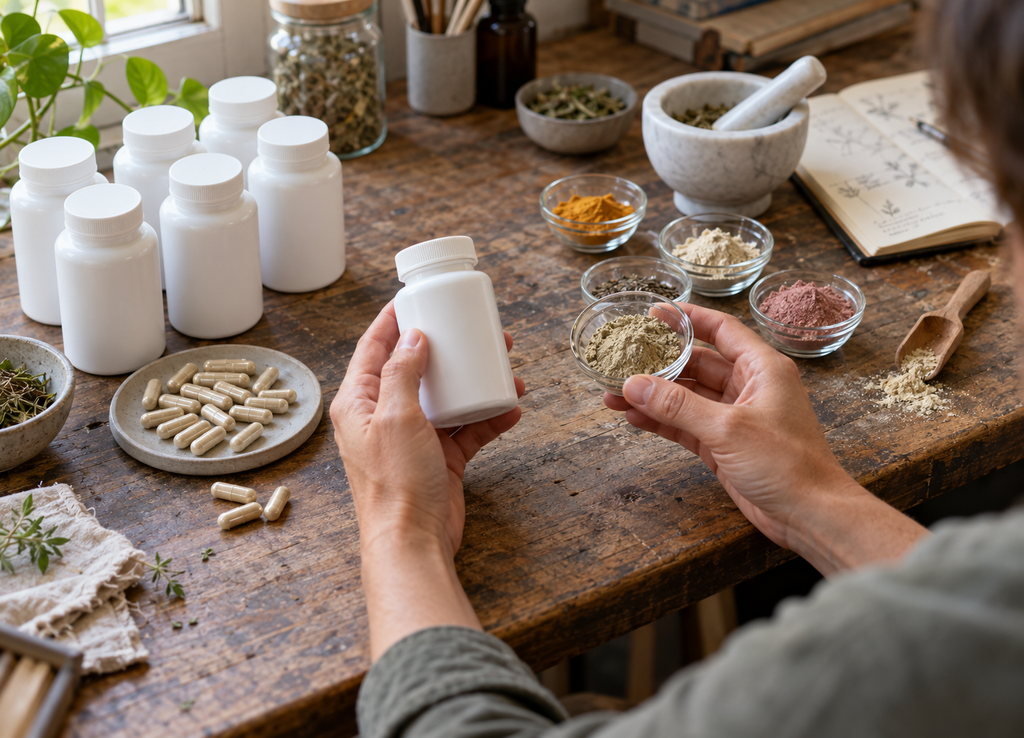
There are two proposals on the table. The first allows production to start relatively quickly: the formulation has already been developed, the raw materials are known, and the manufacturer knows how the product will perform on the production line. The second gives you almost a blank slate. You can tailor the ingredients, dosages, flavour and form precisely to your own brand — but you’ll have to wait longer for the launch.
At first glance, the choice seems simple: a ready-made formulation for budget-conscious consumers, and a formulation developed from scratch for premium brands. In practice, this distinction rarely holds true. A more complex product does not always sell better, and a ready-made base does not necessarily mean yet another identical supplement.
Which route is the right one? The shortest answer is: A ready-made formulation is worth considering when a quick launch, predictability and testing the market are the priorities. Developing a formulation from scratch makes more sense when the brand’s competitive advantage is to stem from the product itself and address a precisely defined customer need. However, before a decision is made, it is worth finding out what both options really entail.
What is a ready-to-use supplement formulation?
A ready-made formulation is a recipe previously developed by the manufacturer and offered as a base for a private-label product. It may be a fixed formulation or a solution that allows for modifications, such as the choice of flavour, number of portions or packaging.
This type of production is often referred to as ‘private label’ or ‘white label’, although these terms are sometimes used in different ways. Therefore, rather than basing your decision on the name of the service alone, it is better to ask the manufacturer:
- which ingredients in the recipe can be changed,
- Is the same product offered to other brands,
- What is the minimum order,
- How long does it take to prepare the first batch,
- who owns the recipe.
‘Ready’ does not mean the product is sitting on the shelf. You still need to sort out the branding, labelling, marketing, production and sales. It is primarily the technological stage that is shorter.
When is a ready-made formulation a sensible choice?
Let’s imagine a brand that has a community and a communication strategy, but doesn’t yet know whether its audience will buy the supplement on a regular basis. A lengthy development process may not be the best way to test this hypothesis.
The finished formulation then offers several significant benefits:
- reduces the time needed to start production,
- reduces the cost of trials and formulation work,
- reduces the risk of technical problems,
- makes it easier to draw up a cost estimate and a timetable,
- enables the company to focus its resources on the brand, sales and customer acquisition.
It can be a good option for a launch product, a seasonal campaign or a brand whose competitive edge does not lie in its unique formulation. Customers often choose a product they understand, trust and which fits into their daily routine.
However, it is important not to treat a ready-made formulation as an automatic shortcut. Even a well-developed formulation must be suited to the target audience, the price, the positioning and the brand promise.
Where do the limitations of the finished composition lie?
The greatest risks usually only become apparent when working on the marketing. The team wants to explain why the product is different, but every suggestion sounds similar to the competitors’ messaging.
If several brands use a similar formula, it is more difficult to build a competitive advantage based solely on the ingredients. The comparison then shifts to price, packaging, the brand’s reach or its advertising budget. A ready-made database may also impose limitations:
- the selection of specific forms and doses of ingredients,
- the ability to target the product at a niche audience,
- flexibility in establishing authorised communication,
- control over the flavour, portion size and user experience,
- the possibility of registering a formula or obtaining exclusive rights.
Such a product can still be successful, but its unique selling point must lie in the brand, convenience, form of delivery, distribution or community. However, a campaign based on the slogan ‘a product like no other’ requires a strong rationale.
What does it mean to create a recipe from scratch?
A bespoke formulation is developed on the basis of a brief for a specific brand. The starting point should not be the question ‘how many ingredients can we add?’, but rather: who are we creating the product for, what need is it intended to meet, in what situation will it be used, and how much is the customer willing to pay for it?
The technologist then assesses the safety and availability of raw materials, dosages, portion sizes, stability, flavour and the production method. The first draft on paper is rarely the final version. The powder may be too bitter, the portion too large, or an attractive ingredient may not be available in the quantities required for regular production.
Creating your own recipe may therefore involve:
- the selection of ingredients and their forms,
- engineering work and cost calculations,
- preparation of samples,
- adjustments to flavour, texture or dosage,
- verification of the consistency of content and communication,
- selection of tests and documentation.
It is a more demanding process, but it allows us to develop a product based on a specific customer need, rather than on a list of items available in the catalogue.
When is it worth investing in your own supplement formula?
Developing a formula from scratch makes the most sense when the product’s uniqueness is a key part of the business model. This applies to specialist brands, premium products and concepts that cannot be reliably realised using a standard formula.
This approach may be appropriate when:
- the brand has its own expertise, methodology or strong product concept,
- Consumers carefully compare the doses and forms of the ingredients,
- the product is intended to occupy a clearly defined position within the wider portfolio,
- There are plans for long-term sales and the development of further variants,
- a specific shape, flavour or way of portioning is required,
- The recipe itself is said to be difficult to compare directly with that of the competition.
Having your own ingredients gives you more material with which to tell the product’s story. However, you must be wary of the ‘more is better’ trap. Twelve ingredients in token amounts are not necessarily better than three carefully selected ones.
Price, lead time and MOQ: where does the difference really lie?
A ready-made formulation usually reduces development costs and the number of trials, but does not guarantee the lowest unit cost. This is still determined by the raw materials, dosages, form, packaging, batch size and scope of services. A standard product in expensive, non-standard packaging may cost more than a bespoke but simple formulation in a standard bottle.
When developing a formula from scratch, you need to take into account the production process, samples, adjustments, testing and longer lead times for raw materials. There may also be a higher minimum order quantity (MOQ), particularly if an ingredient is sourced specifically for the project.
The difference, therefore, is not simply a matter of asking, ‘Which option is cheaper?’. A better question is: How much does it cost to take each option through to the stage where the product can actually reach the customer — and how much capital will be left over for sales afterwards?
Ready-made formulations versus recipes created from scratch – a comparison
| Criterion | Ready-to-use formulation | A recipe from scratch |
|---|---|---|
| Preparation time | Usually shorter | Usually longer |
| Development costs | Lower and more predictable | Higher, depending on the number of attempts and changes |
| Technological risk | Smaller, because the base is already known | Larger at the development stage |
| The ability to stand out through the composition | Limited | Significantly larger |
| Flexibility | Depends on the manufacturer and the available variants | Large, but constrained by technology, legislation and budget |
| Speed of market testing | High | Lower |
| Best use | Quick start, validation, simple product | An expert brand, a premium product, a distinct niche |
The decision should be based on what is most important in the project: time, budget, uniqueness or the opportunity to test the market without a major commitment.
The third approach: a modified base formula
There is a middle ground between these two extremes. The manufacturer can use a tried-and-tested formula and alter selected elements: the dosage, one of the ingredients, the flavour, the portion size or the packaging method.
This approach reduces the amount of technical work involved, whilst better aligning the product with the brand. However, adding a single ingredient can affect the flavour, stability, capsule size, price and marketing messaging. A ‘minor modification’ sometimes requires a reassessment of the entire product.
The hybrid approach can be particularly valuable for brands that want to get off to a quicker start but do not wish to build their marketing strategy around a completely standard product.
Four situations, four different decisions
A new brand on a tight budget. A solid foundation and a successful initial launch mean that some resources can be set aside for customer outreach.
A creator with an engaged community. A tried-and-tested formula or hybrid variant can speed up the launch process. The product still needs to appeal to the target audience — simply having the name on the label is not enough.
An expert in building a premium brand. If the positioning is based on an original concept, a unique formula helps to combine expert knowledge, the composition and the justification for the price.
A company planning to roll out its products on a large scale. What matters is the reliability of supply, unit cost and scalability. An exotic raw material won’t help if a shortage of it halts subsequent production runs.
How can you make a decision without guessing?
Before speaking to the manufacturer, it is worth answering seven questions:
- What should be the main reason for a customer’s choice of product?
- Does a brand’s competitive advantage stem from its formulation, or rather from its marketing, convenience and distribution?
- What is the actual budget for the whole launch, not just for production?
- When does the product need to go on sale?
- Has the demand been confirmed in any way yet?
- How easily can competitors compare a product based solely on its label?
- Can the formula be produced regularly on the planned scale?
If the answers are still unclear, there’s no need to go straight for the most advanced option. Sometimes the first batch is primarily intended to provide insights: who is buying, what price works, and whether the customer returns for another pack.
The most common mistakes when choosing a formulation
Problems usually arise when choosing a recipe is treated as a substitute for a strategy. The most common mistakes include:
- choosing a ready-made base simply because it can be produced quickly,
- developing a bespoke formula without a confirmed customer requirement,
- adding ingredients simply to make the list of ingredients longer,
- failing to take into account the costs of marketing, storage and the next batch,
- promising uniqueness without establishing exclusivity or rights to the formula,
- failure to take into account the availability of raw materials when scaling up,
- starting work on the packaging design before the final portion size and composition have been finalised.
The best formula isn’t the most complicated one. It’s the one that suits the customer’s needs, the brand’s capabilities and the actual sales approach.
How does Pharma Dot help you choose the right path?
At Pharma Dot, we start by discussing the target audience, the sales model, the budget and the brand’s plans. Only on this basis can we honestly assess whether the project requires bespoke development, a tried-and-tested formulation or an intermediate solution.
We support the entire process: from refining the concept and selecting the format, through product development, production and packaging, right through to organising logistics and fulfilment. This ensures that the formulation is not developed in isolation from the price, packaging, launch date and subsequent scaling.
Do you have an idea for a supplement, but aren’t sure whether it’s worth developing it from scratch straight away? Let’s discuss what really sets a product apart. Sometimes the advantage lies in a unique formula, whilst at other times it’s a carefully chosen simplicity and a quicker time-to-market.
FAQ – a ready-made formulation or a formulation from scratch?
Does the finished formulation mean that the supplement is the same as the competitors’?
Not always, but it may be offered to multiple brands in an identical or very similar version. The extent of exclusivity and the scope of possible changes depend on the manufacturer. It is worth clarifying this before signing the contract and checking what, apart from the composition, will set the product apart.
Can a ready-made supplement sold under our own brand be modified?
This is often the case, although the scope for modification may be limited. Sometimes it is possible to change the flavour, the packaging or certain ingredients. Any change should be assessed in terms of technology, cost and product compliance.
How long does it take to develop your own supplement formula?
The time required depends on the form, ingredients, number of trials, availability of raw materials, testing and packaging. A simple formula can be developed relatively quickly, whilst a product requiring numerous adjustments or non-standard technology may take several months to prepare.
Does a formulation developed from scratch always require a higher MOQ?
Not always. The MOQ depends on the production process, the availability of raw materials, the size of the packaging and the specific manufacturer’s terms and conditions. However, individual components or raw materials ordered specifically for a project may increase the minimum order quantity.
What is the best choice for a supplement brand’s first product?
If a brand is still gauging demand and has a limited budget, a ready-made formulation or a modified base often helps to minimise the risk. However, if the entire concept is based on proprietary knowledge and a specific product differentiator, developing an in-house formulation may be justified right from the first production run.




